
What is a fair hourly rate for a babysitter? In this in-depth guide, you’ll find everything you need to know about babysitting costs in the UK. Including practical examples, an overview of current UK minimum wage rates, and helpful tips to help you agree on a fair and responsible babysitting rate.
Wondering how much a babysitter costs in the UK in 2026? Whether you’re hiring a teenager for occasional evening help or a professional nanny with qualifications, babysitting rates can vary widely depending on location, experience, and level of responsibility.
In this guide, you’ll find average hourly rates, real-life examples, and practical tips to help you set a fair, safe, and responsible rate for your babysitter.
Average Babysitting Rates in the UK (2026)
According to recent data, the average hourly rate for babysitters in the UK in 2026 is around £11.38. However, actual babysitting rates vary significantly depending on where you live. For example, babysitters in London often earn between £12 and £18 per hour, reflecting the city’s higher cost of living and greater demand for childcare.
In other major cities like Edinburgh, Manchester or Bristol, rates typically range from £11 to £13 per hour. In smaller towns or rural areas, average rates are often closer to £9 to £11 per hour. These local differences are an important consideration when agreeing on a fair rate — both for families and babysitters.
Babysitting rates also vary depending on other factors, such as:
- The babysitter’s age and experience
- Any qualifications (like First Aid or childcare training)
- The number and age of children
- The region or city you live in (rates are higher in cities like London)
- The type of care required (daytime vs evening, casual vs regular)
This data is based on national averages from babysitting platforms and Sitly’s internal research.
Table: Average Babysitting Rates by UK Region (2026)
| Location | Typical Hourly Rate | Notes |
| London | £12.00 – £18.00 | Highest rates due to cost of living and high childcare demand |
| Major cities | £11.00 – £13.00 | Includes Edinburgh, Manchester, Bristol, etc. |
| Medium towns | £10.00 – £12.00 | Includes cities like Sheffield, Leicester, or Cardiff |
| Small towns / rural areas | £9.00 – £11.00 | Lower demand and cost of living |
The Type of Babysitter You Hire Makes a Big Difference
The kind of babysitter or nanny you hire has a direct impact on pay expectations:
- A professional nanny (with qualifications, fixed hours, and sometimes live-in arrangements) will typically charge between £13 and £20+ per hour, or may receive a monthly salary ranging from £2,000 to £3,500, depending on responsibilities and location.
- A 16-year-old student providing occasional evening care might ask for around £8 to £10 per hour, especially in smaller towns or suburban areas — often close to the legal minimum wage for their age.
When setting a rate, it’s important to factor in not just the hours worked, but also the level of responsibility involved. Tasks like caring for babies or toddlers, managing multiple children, preparing meals, or handling school pickups usually justify a higher hourly rate.
On Sitly, you can browse the profiles of babysitters available in your area and see the hourly rates they charge. You can also post a babysitting job request, specifying the hourly rate you’re willing to pay.
Babysitting Rates and the UK Minimum Wage
In the UK, there is a National Minimum Wage (NMW) and National Living Wage required for babysitters and nannies who are:
- Formally employed (i.e. regular hours, not casual/occasional help)
- Not family members or volunteers
- Treated as workers under UK employment law
Minimum Wage Rates as of April 1st, 2026
| Age group | Minimum hourly wage |
| 21 and over | £12.71 |
| 18 to 20 | £10.85 |
| Under 18 | £8.00 |
| Apprentices | £8.00 |
(Source: gov.uk – National Minimum Wage)
If your babysitter is a regular part of your family’s childcare routine, pays tax, or has fixed working hours, they are likely entitled to the legal minimum wage. However, if you occasionally hire a teenager for a few hours on a Saturday night, these arrangements are often seen as informal and not strictly covered by employment law — though it’s still good practice to pay fairly and responsibly.
Hourly vs. Fixed Babysitting Rate: What’s Common in the UK?
In the UK, most babysitters are paid by the hour, especially for occasional, flexible, or last-minute care. This approach ensures fair pay based on actual time and effort — and it’s the most common setup for evening babysitting or ad hoc support. However, in some situations — like a regular weekly arrangement or a quiet evening when the children are already asleep — families and babysitters may agree on a fixed or flat rate instead.
Hourly pay is ideal when:
- The schedule changes week to week
- Tasks vary (e.g. bedtime, dinner, school pickups)
- You sometimes need last-minute help
- You want to ensure the sitter is fairly paid even if plans shift
This way, the babysitter is compensated for every hour (or part of an hour) they work, especially if unexpected responsibilities arise.
Fixed or flat rates can work well when:
- The arrangement is predictable and routine (e.g. every Saturday, 6–11 p.m.)
- There are no extra tasks, and the children are typically already asleep
- Both parties prefer a simple, budget-friendly setup
What to Keep in Mind with Fixed Babysitting Rates
If you choose a flat rate, be sure to:
- Agree in advance on what’s included: number of children, whether light housework is expected, late-night hours, or transport costs
- Avoid underpaying the babysitter if plans change or the workload increases
- Top up or offer a small bonus if they stay later, cook meals, or handle unexpected situations
Example
A family and babysitter agree on a flat rate of £55 for a 5-hour evening (7:00 p.m. to midnight), when the children are already in bed and no extra tasks are required. If the sitter arrives earlier to help with dinner, washes dishes or tidies up, stays past midnight due to a delay it is reasonable to add an hourly supplement to keep the arrangement fair.
How Experience and Qualifications Affect Babysitter Rates
A babysitter’s experience, training, and certifications significantly affect their expected rate — and justifiably so. It’s not just about age. A 20-year-old student studying early years education, or holding a paediatric first aid certification, will typically charge £13–£16 per hour, depending on the region.
Even a 15-year-old with consistent babysitting experience might ask for more than the minimum wage, and families often agree — especially if the sitter is reliable, known to the family, and has proven they can manage well. In general: the more skilled or qualified the babysitter, the higher their expected rate.
It’s a Personal Decision. As a parent, you get to decide what feels right for your situation. Do you feel comfortable hiring someone who’s just getting started — and paying a bit less while they gain experience? Or would you rather work with someone who has a childcare background and qualifications, and are happy to pay more for that added peace of mind?
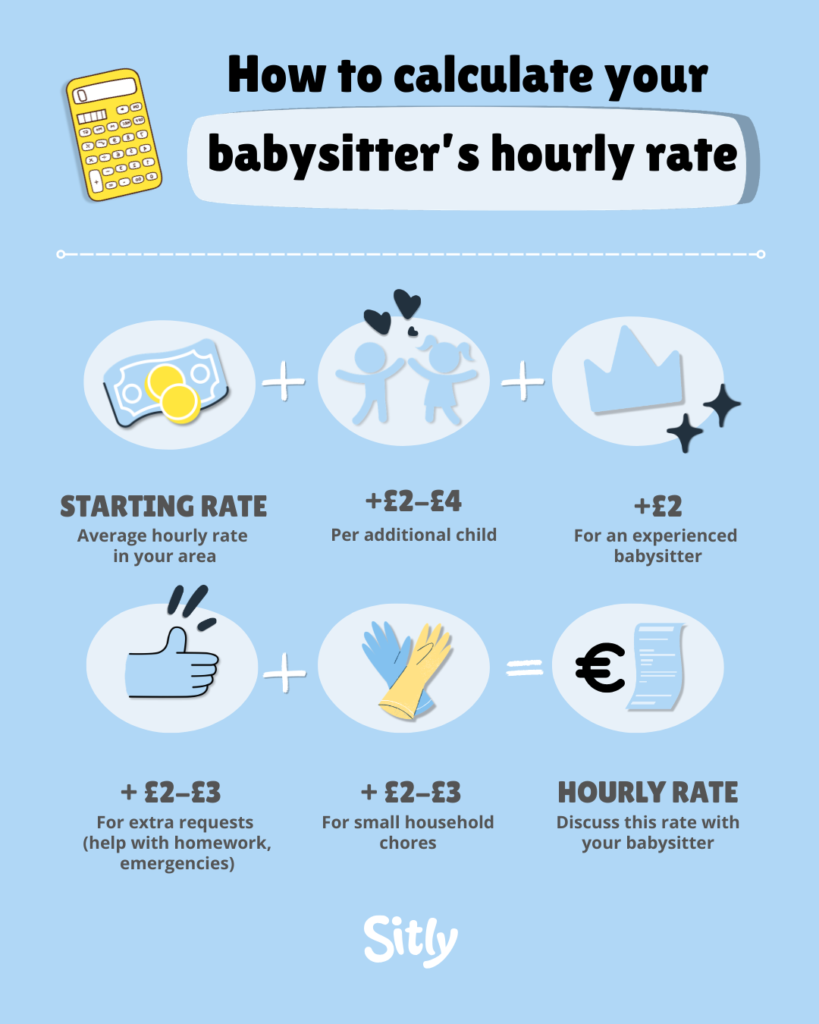
There’s no one-size-fits-all answer — just an agreement that works well for both sides. If you’d like a guideline to help calculate fair babysitting wages in the UK, take a look at the visual reference below.
What Tasks Does Your Babysitter Handle?
The hourly rate for a babysitter in the UK doesn’t just depend on their age or experience — it also depends on what they’re expected to do during their time with your children. If your babysitter is taking on additional responsibilities, it’s fair to reflect that in their pay. Here is some examples of tasks that may justify a higher rate:
- Caring for multiple children:
Managing two or three children at once is considerably more demanding than looking after just one. It often requires more energy, attention, and planning — and the hourly rate should increase accordingly. - Special care needs:
If your child has medical conditions, behavioural challenges, or requires close, consistent supervision, it’s entirely appropriate to offer a higher hourly rate.
Example: Babysitter (18 years old) – 3 Children + Dinner Prep
Sarah is 18 years old and has extensive babysitting experience. She recently started a teacher training course and holds a paediatric first aid certificate. Once a week, she works for a family with three children aged 8, 5, and 3. She arrives at 3:00 PM, picks up the older children along with the toddler from school, and brings them home for snacks and playtime. The parents also appreciate it when she prepares dinner, so the whole family can eat together when they return around 5:30 PM.
Rate Breakdown
- £11 /hour → Average rate in your area (for age 18–20)
- £3.00/hour → For managing two additional children
- £1.50/hour → For experience and first aid certification
= £15.50/hour
She works for 2.5 hours, so her pay is: £15.50× 2.5 = £38.75
The family rounds up to a flat £40 per session — a fair and easy arrangement for both sides.
Babysitting Babies vs. Older Children
The age of your children plays an important role when deciding on a fair babysitting rate. Caring for a baby or toddler requires constant attention and hands-on support. The babysitter may be feeding, changing nappies, soothing the child, or keeping them engaged — often all within a short time span. This level of responsibility justifies a higher hourly rate, especially if the sitter has experience with infants or paediatric first aid training. If you’re unsure whether your little one is ready to stay with a babysitter, you can read our guide on when a baby is ready to be left with a babysitter.
With children aged six and up, the role is often a bit more relaxed. Older children can usually eat on their own, use the toilet independently, and entertain themselves with minimal supervision. As a result, the workload is lighter, and the hourly rate may reflect that. In general: the younger and more dependent the child, the greater the responsibility — and the higher the pay should be.
Household Tasks and Light Cleaning
If you ask your babysitter to help with light housework in addition to childcare, it’s completely reasonable to increase their pay. Babysitters are there first and foremost for the children — but if they’re also tidying up, folding laundry or preparing meals, that extra work should be reflected in the rate.
To give some context: a domestic cleaner in the UK typically earns between £12 and £18 per hour. If your sitter is handling both childcare and cleaning, their rate should sit comfortably above the average for basic babysitting. Common tasks that may justify a higher babysitting rate include:
- Vacuuming shared areas
- Loading or unloading the dishwasher
- Folding and sorting laundry
- Washing dishes after meals
- Preparing dinner for the children or the family
Evening Babysitting vs. Daytime Babysitting
Is your babysitter only staying in during the evening, or are they helping with the after-school routine too? Evening babysitting is often paid at a slightly highe rate. In some cases, families and sitters agree on a flat rate for the night — or a lower hourly rate after a certain time especially if:
- The children are already asleep when the sitter arrives
- There’s little active care required throughout the evening
Example: Babysitter (16 years old) – 2 Children, Weekend Evenings
Lia is a 16-year-old secondary school student in Year 11. She has over two years of babysitting experience, mostly with her younger brother and cousins. She occasionally looks after two children on weekend evenings. When she arrives at 7:30 PM, the children are already asleep. She stays until 11:30 PM, and the parents drive her home afterward. They also provide snacks and drinks and ask her to unload the dishwasher during the evening.
What’s a reasonable rate for Lia?
- £8.50/hour → Suggested rate for a teenage babysitter with light duties
- + £2.00/hour → For supervising an additional child
= £10.50/hour
However, because the children are already asleep and there’s little active care involved, Lia and the parents agree on a flat rate of £9/hour.
Total pay: £9× 4 hours = £36.00
Lia is very happy with this arrangement: it’s a quiet evening, she feels trusted, and the rate reflects the light responsibilities.
Last-Minute or On-Call Babysitters
Need a babysitter on short notice? That kind of flexibility often comes with a higher rate. Spontaneous bookings — especially for early mornings or unexpected situations — may require the babysitter to cancel personal plans or rearrange their day. When this happens, it’s good practice to offer a slightly higher hourly rate, both as a thank-you and to acknowledge the inconvenience. Last-minute availability is convenient for you, but it should be rewarded fairly.
Example: Babysitter (21 years old) – 1 Child, After-School Care & Lunch Prep
Nina is 21 and currently studying Early Childhood Education. She holds a paediatric first aid certificate and has a flexible university schedule this term.
Every Wednesday afternoon, she babysits one child for a regular family. She picks up the 6-year-old boy from school at 3:00 PM, prepares lunch, plays with him, and stays until the parents return around 6:00 PM. The child is very active, so Nina stays engaged the whole time. The family provides all lunch supplies and reimburses small expenses like bus fare or snacks.
What’s a reasonable rate for Nina?
- £13/hour → Typical rate for qualified babysitters in the UK
- + £1.00/hour → For first aid certification and childcare qualifications
- = £14.00/hour
She works for 3 hours, so the total is: £14.00 × 3 = £42.00.
Talking About Pay With Your Babysitter
Once you’ve decided on a fair hourly rate, the next step is to talk it through openly with your babysitter. These conversations can feel a bit awkward — especially if it’s your first time hiring someone — but being clear from the start is the best way to avoid confusion or misunderstandings later on.
A good approach is to ask your babysitter if they already have a rate in mind. Most sitters — particularly teenagers and students — will have a rough idea of what they expect to earn, based on their experience, age, or what their friends are paid. If both of you come to the conversation with realistic expectations and can explain your reasoning, it becomes much easier to agree on a rate that feels fair and sustainable on both sides.
In the end, a respectful, upfront conversation builds trust — and it makes it more likely that your babysitter will feel valued, stay motivated, and remain a reliable part of your family’s support system.
So, What Should You Pay a Babysitter in the UK?
There’s no one-size-fits-all answer when it comes to babysitting rates — and that’s because every family and every sitter is different. The right amount to pay depends on a mix of factors, including:
- The babysitter’s age, experience, and any qualifications (such as First Aid or paediatric CPR)
- The number of children and their ages
- Whether there are extra tasks involved, like preparing meals, helping with homework, or light household duties
- Whether the care takes place during the day, in the evening, or includes overnight stay
- Your location — rates in major cities like London or Manchester are typically higher than in smaller towns or rural areas
- And of course, your personal budget
In the end, it’s about finding the right balance between fair pay for the sitter and reliable, affordable care for your family. The most important ingredient? Clear communication. Be open with your babysitter about what you need and what you’re able to offer. When both sides understand each other’s expectations, it’s much easier to agree on a rate that works for everyone.
Table of contents


FAQ

In 2026, most parents in the UK pay between £12 and £16 per hour for a babysitter. Rates vary depending on your location, the sitter’s experience, and the number of children. In London, babysitters often charge closer to £15–£20 per hour, while smaller cities, towns, or rural areas may see rates around £10–£13 per hour.
According to recent data, the average hourly rate for babysitters in the UK in 2026 is around £11.38. However, actual babysitting rates vary significantly depending on where you live. For example, babysitters in London often earn between £12 and £18 per hour, reflecting the city’s higher cost of living and greater demand for childcare.
Yes, most babysitters in the UK charge more when caring for more than one child. The typical increase is £2–£4 extra per hour per additional child, depending on their ages and individual needs.
Babysitter rates in London are among the highest in the UK, averaging around £12–£18 per hour, with some experienced sitters charging more.


Trusted sitters, right around the corner
Need a little help? Sitly connects you with experienced babysitters in your area. Whether you need occasional or regular care, finding the right babysitter is super easy. Browse profiles, read reviews, and reach out to your favorites right away.

Related Articles

8 Ways to Find a Babysitter Near You
Not sure where to find a babysitter near you? Here are 8 ways to do it, from babysitter platforms and agencies to local referrals, plus specific tips for last-minute, overnight, and newborn care.

Night Babysitter: How to Find One and Tips for a Smooth Night
Need a babysitter who can stay overnight? Here's how to find a reliable night babysitter, what sets a night nanny apart, and what to agree on before the night starts, from pay to house rules.

How to Find a Last-Minute Babysitter Without Stress
Looking for a last-minute babysitter doesn't have to be stressful. Learn how to build an emergency babysitter list, find trusted local sitters quickly, and prepare for unexpected childcare needs before they arise.